

Ansarr: Bridging the gap between people and insights
I designed and built Ansarr, a marketplace where researchers pay real people to take part in their studies. A researcher publishes and funds a study, matched respondents complete it on their phones, and they get paid.
Money moves between strangers here, so one rule led the design: credibility first, warmth second. Earnings green appears only where money is earned. Everything else stays flat and quiet, which also keeps it quick on a low-end Android phone.
Fund research: step by step
- 1Details
- 2Audience
- 3Reward
- 4Review
- 5Build the survey
- 6Fund and go live
The first four steps are one form underneath. Every field stays on the page, so the audience estimate, the minimum reward and the cost can read across steps.
Live matching system
A green sweep means still matching. The first response turns it into a progress bar.
Selected app screens: researcher and respondent



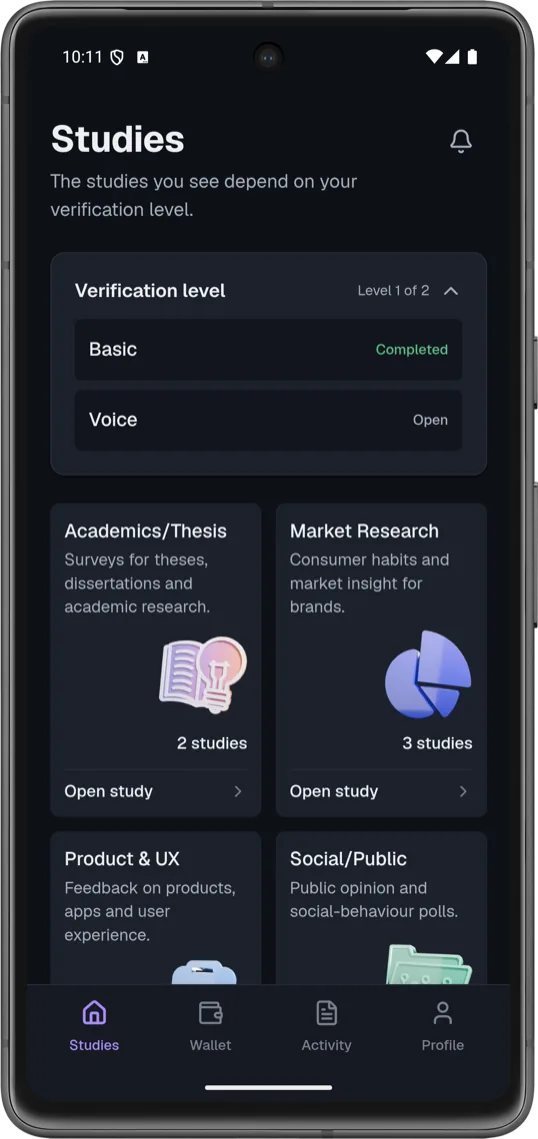
The studies feed
The feed opens on kinds of study, not one long list. Grouping studies by type was an early decision, so new categories can be added without redesigning the page.
Each card shows how many studies of that type the respondent qualifies for.
A researcher creates a study.
Eight minutes on step one sets the ₦4,000 minimum reward on step three, and the audience count updates as filters change. It ends on the fund screen, where the total is worked out by the database.
Decisions I took
I engineered Ansarr end to end: the web app, the mobile app and the database behind both. Above is the product running on a real device, followed by the decisions that shaped it and what each one cost.
-
Wrap the live site, don't write a second app
Why One codebase. A web deploy reaches every phone, and only changes to the native shell go through the app stores.
Cost Every screen is a trip to a server, which sets a ceiling on speed.
-
Measure before optimising
Why I built a test page that talks to the database straight from the phone. Data came back in about 200 milliseconds on 4G, so the database wasn't the problem.
Cost It pointed at the expensive fix: move the interface into the app and fetch only data. That version runs on the emulator and isn't shipped yet.
-
Money only moves inside the database
Why Every balance change happens in one database function that checks who owns what. Amounts are whole numbers of kobo, and the app never sends a total to be trusted.
Cost More logic lives in SQL, which is harder to test than app code.
-
Send a push by adding a row
Why Any feature that needs to notify someone adds a row to one table. A trigger and one server route do the rest, so the in-app list and the lock screen never disagree.
Cost A failure is silent unless you go looking. I learned that when Android dropped messages sent to a channel that didn't exist.
-
Refuse to be embedded, and keep the product off the public web
Why ansarr.com tells browsers not to show it inside another page, and product screens only open in the app. For something that holds people's earnings, that's the safe default.
Cost It's why this page shows recordings and not a live frame.